
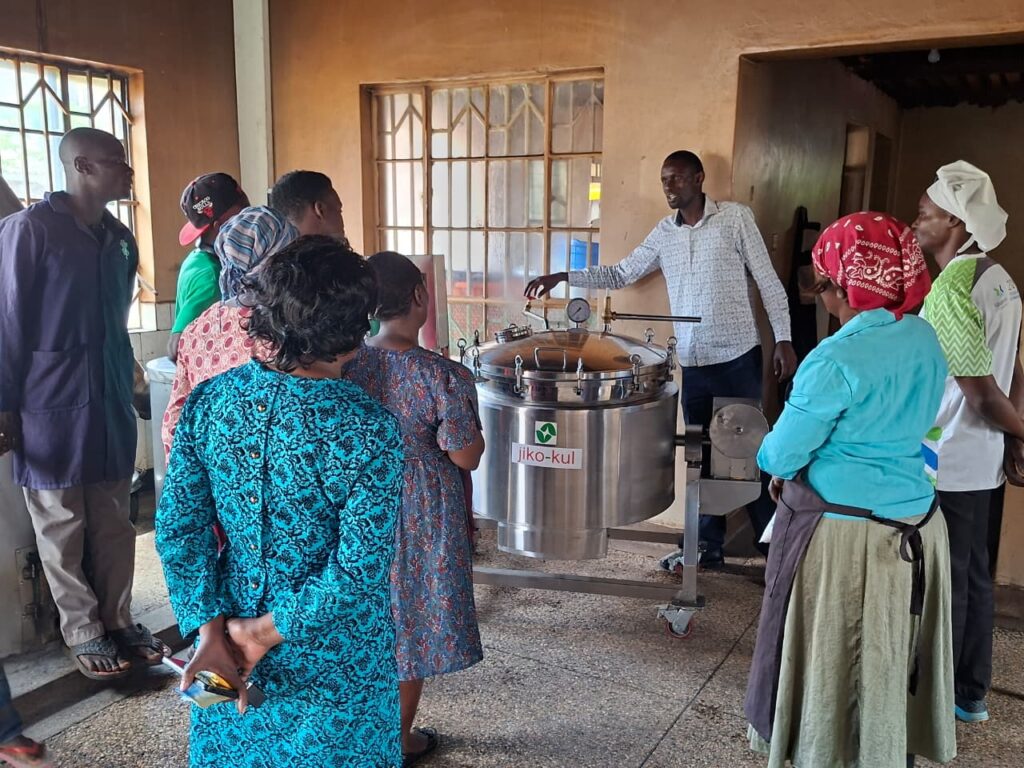
They share a name. They share a mission. And now, they share something else – neither of them burns firewood anymore.
Stepping Stones has two campuses. One in Ngoingwa. One in Makongeni. Two neighborhoods, two kitchens, two sets of students waiting to be fed every day. For years, both kitchens ran on the same fuel: firewood. Expensive, smoky, slow, and getting harder to source with every passing term.
Today, both kitchens run on the sun.
The Problem, Doubled
Running one school kitchen on firewood is expensive. Running two is punishing.
Every cost is duplicated. Every inefficiency is mirrored. Two firewood budgets. Two teams of kitchen staff breathing smoke. Two sets of students waiting hours for meals to cook. Two supply chains to manage, two price negotiations every season, two kitchens deteriorating under soot and heat.
For Stepping Stones, the pain was not abstract. It was line items in a budget. It was coughing in two kitchens instead of one. It was the quiet, compounding realization that the school was spending a significant portion of its operational resources simply on the act of heating food.
Something had to give.
One Decision, Two Installations
Stepping Stones did not pilot clean cooking at one branch and wait to see. They committed to both.
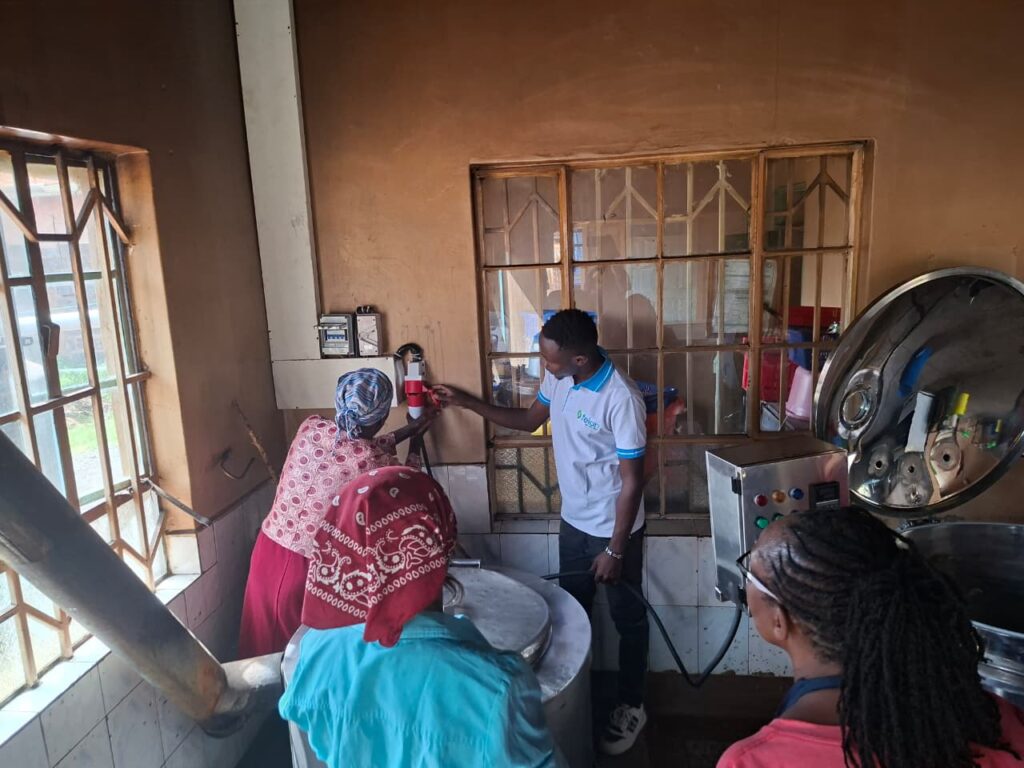
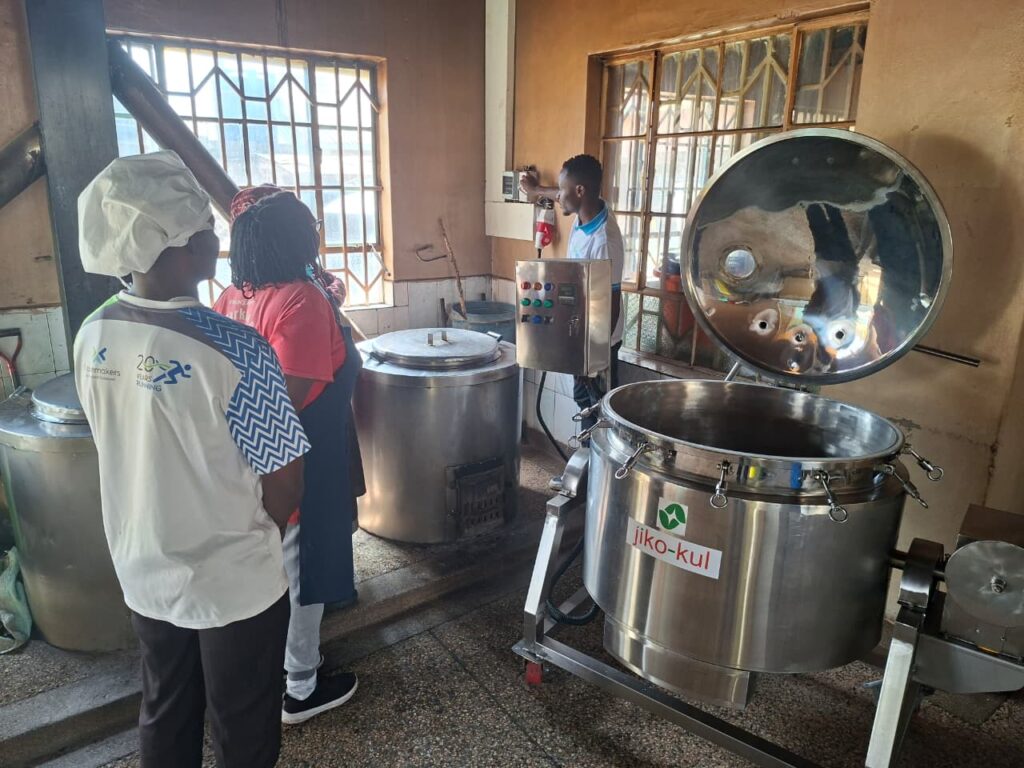
Feion Green Ventures installed a 200-litre Jiko-Kul Electric Pressure Cooker at the Ngoingwa campus and a second 200-litre unit at Makongeni – each one powered entirely by a dedicated solar PV system.
Read that again. These kitchens are not connected to the grid. They are not burning diesel to generate electricity. They are cooking with sunlight.
A solar panel on the roof. A pressure cooker in the kitchen. Beans in under an hour. No utility bill. No firewood. No smoke. No compromise.
Why Solar Changes the Calculation
Electric cooking is transformative. Solar-powered electric cooking is something else entirely.
When a school plugs a Jiko-Kul into the grid, it eliminates firewood and gains speed, health, and savings. That alone is significant. But it still carries an electricity bill – smaller than the firewood cost, predictable, manageable, but present.
When a school powers the Jiko-Kul with solar, it eliminates the fuel cost altogether. Not reduces. Eliminates.
The sun does not invoice. It does not increase its rates during the dry season. It does not require a procurement officer to negotiate terms. It arrives every morning, free of charge, and Stepping Stones converts it directly into cooked meals.
This is what zero operational energy cost looks like. And once installed, the economics only improve with time – because the equipment is paid off while the sun keeps showing up.
6:00 AM, Ngoingwa Campus
The kitchen is bright. Not the dim, smoke-filtered light of a firewood kitchen – actually bright, because there is no haze hanging in the air.
The cook arrives, measures out rice and water, loads the 200-litre Jiko-Kul, seals the lid, and sets the pressure. The solar system has been charging since dawn. There is nothing to light, nothing to fan, nothing to watch nervously in case the fire dies.
She steps out of the kitchen. She has time now. Time, she did not have six months ago, when the first hour of her morning was spent coaxing wet wood into flame.
By 7:30, the rice is done. Perfectly cooked. No burnt bottom. No half-raw center. Just consistent, even, pressurized cooking that delivers the same result every single time.
6:00 AM, Makongeni Campus
Twelve kilometers away, the scene is almost identical.
Same cooker. Same solar system. Same calm. A different cook, loading beans this time, but the rhythm is the same – measure, load, seal, press.
This is what replication looks like. Not a one-off success story, but a model that works identically across locations, across cooks, across menus. The Jiko-Kul does not depend on the skill of the fire-maker or the quality of the charcoal. It depends on engineering. And engineering is consistent.
By lunchtime, both campuses have served hot, nutritious meals. Neither kitchen has produced a single wisp of smoke. Neither school has spent a single shilling on fuel.
Two kitchens. One sun. Zero firewood.
The Ripple Effects
For the Budget
Stepping Stones used to maintain two separate firewood supply chains. Two vendors, two delivery schedules, two-line items that grew every year. That entire cost category is now gone.
The savings are being reinvested where they belong – into classrooms, learning materials, teacher development, and the things that define a school’s quality. The kitchen no longer competes with the library for funding.
For the Staff
Kitchen work at Stepping Stones is no longer hazardous duty. No smoke inhalation. No burns from open flames. No hours spent hunched over a fire, feeding it, adjusting it, breathing it in.
The cooks still cook. But they cook in a clean, ventilated space, operating equipment that respects their time and their health. That shift – from endurance to professionalism – changes how people feel about their work.
For the Students
Meals are ready on time. Every day. The food is better – pressure-cooked beans and grains have a texture and tenderness that firewood cooking rarely achieves consistently. Students eat well, and students who eat well learn better. The research is clear on this. Stepping Stones is living it.
For the Environment
Two solar-powered cookers mean two kitchens producing zero emissions from cooking. No CO₂ from burning wood. No particulate matter. No contribution to the deforestation that is stripping Kenya’s forest cover year by year.
It is a small intervention at the scale of one school. But Stepping Stones is not one school. It is a model – and models are meant to be copied.
The 200-Litre Sweet Spot
Not every school needs a 500-litre industrial cooker. Stepping Stones proves that the 200-litre Jiko-Kul is the right fit for small-to-medium institutions – schools with a few hundred students, where the cooking demand is real but the scale is manageable.
The 200-litre unit is compact enough to fit into existing kitchen spaces without renovation. It is powerful enough to handle the full daily menu. And when paired with solar, it creates a fully self-contained cooking system that requires nothing from the outside – no grid, no fuel, no supply chain.
For schools in areas where grid electricity is unreliable or unavailable, this combination is not a luxury. It is the only viable path to clean cooking.
What Two Branches Teach Us
There is a reason the Stepping Stones story matters beyond Stepping Stones.
Single installations prove that the technology works. Dual installations – across two separate sites, two separate kitchens, two separate operating environments – prove that it scales.
The Ngoingwa cooker was not a prototype and the Makongeni cooker a refined version. They are the same system, deployed identically, performing identically. That consistency is the foundation of any national rollout. It means the next school does not need a custom solution. It needs the same one.
Feion Green Ventures has now deployed across institutions ranging from large secondary schools to compact academies like Stepping Stones. The pattern holds. The Jiko-Kul works. The solar integration works. The economics work. The health outcomes are real. The environmental impact compounds.
What varies is only the size of the cooker and the size of the solar array. Everything else is proven.
The Quiet Revolution
There is no dramatic moment in a solar-powered kitchen. No fire to light. No smoke to signal that cooking has begun. Just a hum, a sealed lid, and the knowledge that somewhere on the roof, photons are becoming lunch.
It is quiet. It is clean. It is working right now, at two campuses, feeding students who may never know what a firewood kitchen smelled like.
That is the point.
The revolution is not supposed to be loud. It is supposed to be so effective, so seamless, so obviously better that the old way becomes unthinkable.
At Stepping Stones, it already is.
The Invitation
If your school runs two campuses, you are paying for firewood twice. If your school runs three, you are paying three times. The maths does not improve with scale – it worsens.
Solar-powered electric cooking breaks that cycle entirely. And the model is ready.
School administrators: the path from firewood to solar cooking is shorter than you think. We will show you the numbers for your specific institution.
Development partners and financiers: multi-site deployments like Stepping Stones are the proof that this scales. Fund the next ten. Fund the next hundred.
County governments: your education budget is being consumed by firewood. There is a better way, and it is already working in your jurisdiction.
Two kitchens. One sun. Zero firewood. Zero smoke. Zero compromise.
The future of school cooking is not waiting. It is already cooking lunch.Feion Green Ventures designs, manufactures, and deploys the Jiko-Kul Electric Pressure Cooker and solar hybrid systems for schools and institutions across Kenya. To explore a solar-powered cooking solution for your institution, reach us at info@feiongreenventures.com