
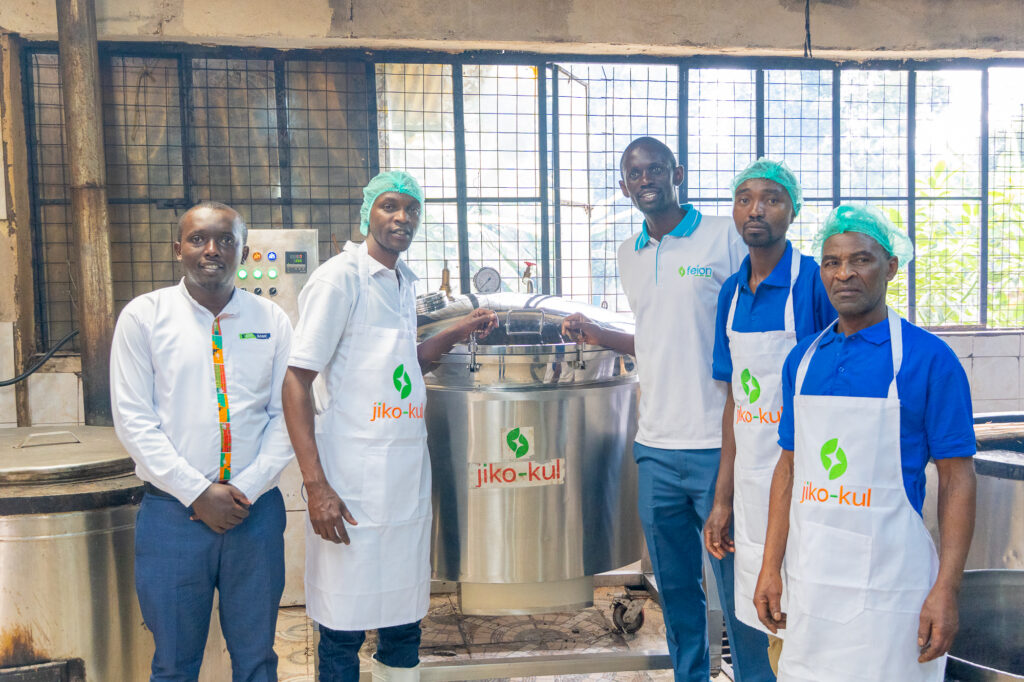
There is a moment – quiet, unremarkable – when a school kitchen lights its last firewood fire. No one takes a photograph. No one makes a speech. A cook simply turns away from the woodpile, walks to a steel machine that stands taller than she does, and presses a button.
At Ndima kanini Academy, that moment arrived on a Tuesday.
And nothing has been the same since.
5:47 AM — Before
Picture the old kitchen.
It is not yet six o’clock, and the first cook has already been working for twenty minutes. She is arranging firewood – heavy, damp from last night’s rain, and more expensive than it was last term. The smoke hasn’t started yet, but it will. It always does.
By 7 AM, the kitchen will be a haze. Her eyes will sting. Her lungs will carry that familiar tightness she has learned to ignore. But there are hundreds of students to feed, and the beans are not going to cook themselves.
The beans. They take the longest. Four hours, sometimes five, depending on the firewood, depending on the weather, depending on luck. By the time lunch is served, the morning is gone. The firewood budget is thinner. And tomorrow, it starts again.
This was the rhythm at Ndima kanini Academy for years.
Until Feion Green Ventures arrived with a different question:
What if feeding a school didn’t have to cost this much – in money, in health, in time, in trees?
The Machine That Changed the Kitchen
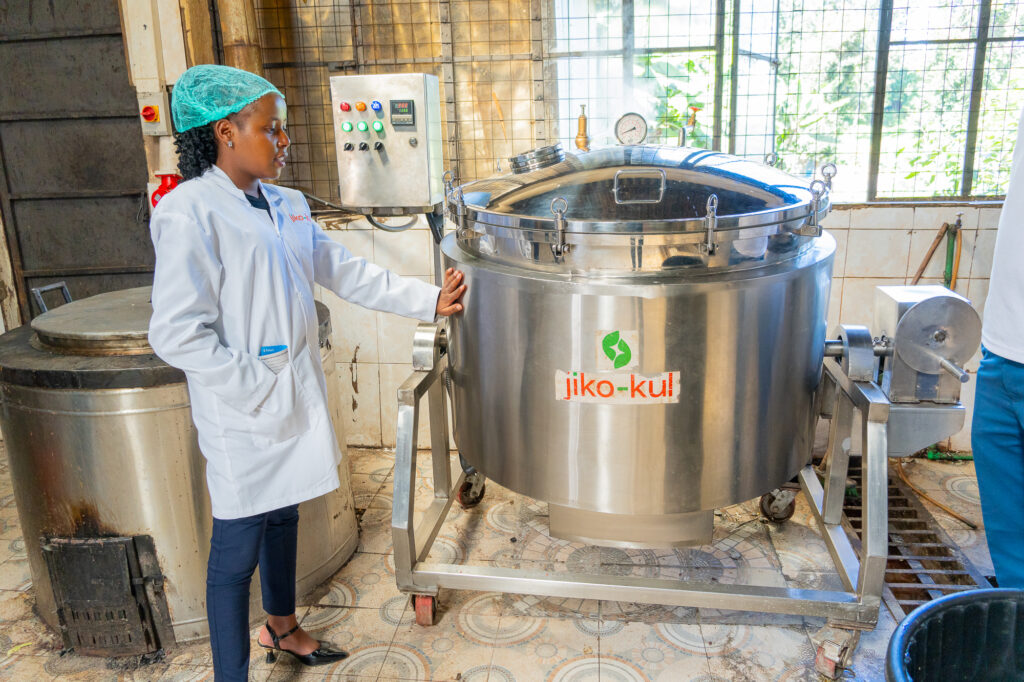
The Jiko-Kul 500-Litre Electric Pressure Cooker does not look like a revolution.
It looks like a large, polished steel vessel – industrial, purposeful, quietly impressive. It has no chimney. It produces no smoke. It asks for no firewood, no charcoal, no kindling, no matches.
It asks only for electricity. And time. Far less time than anyone expected.
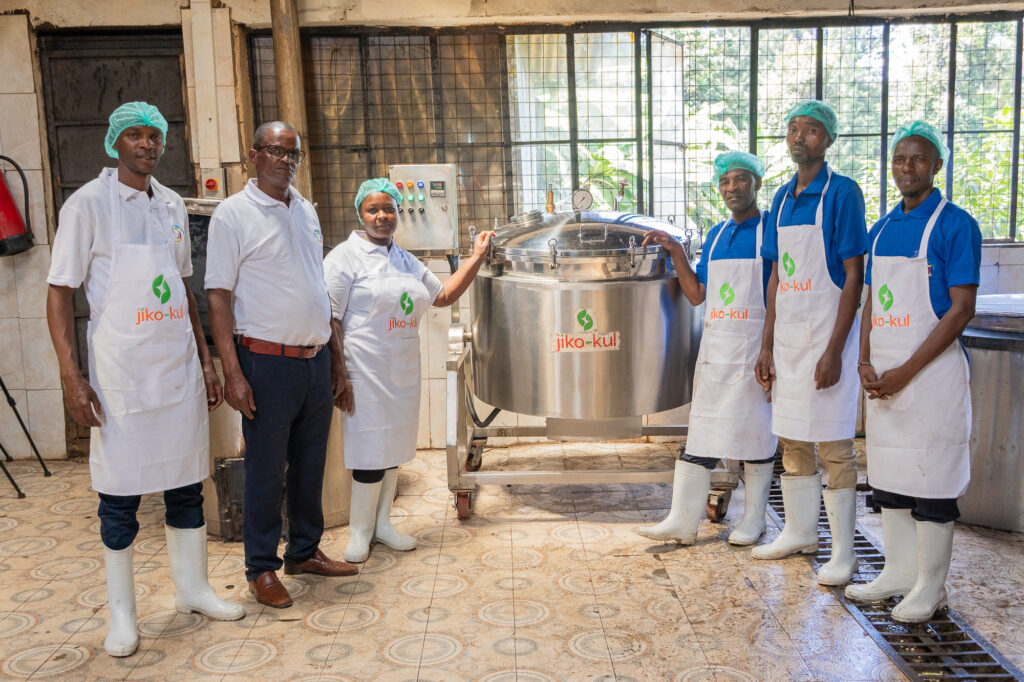
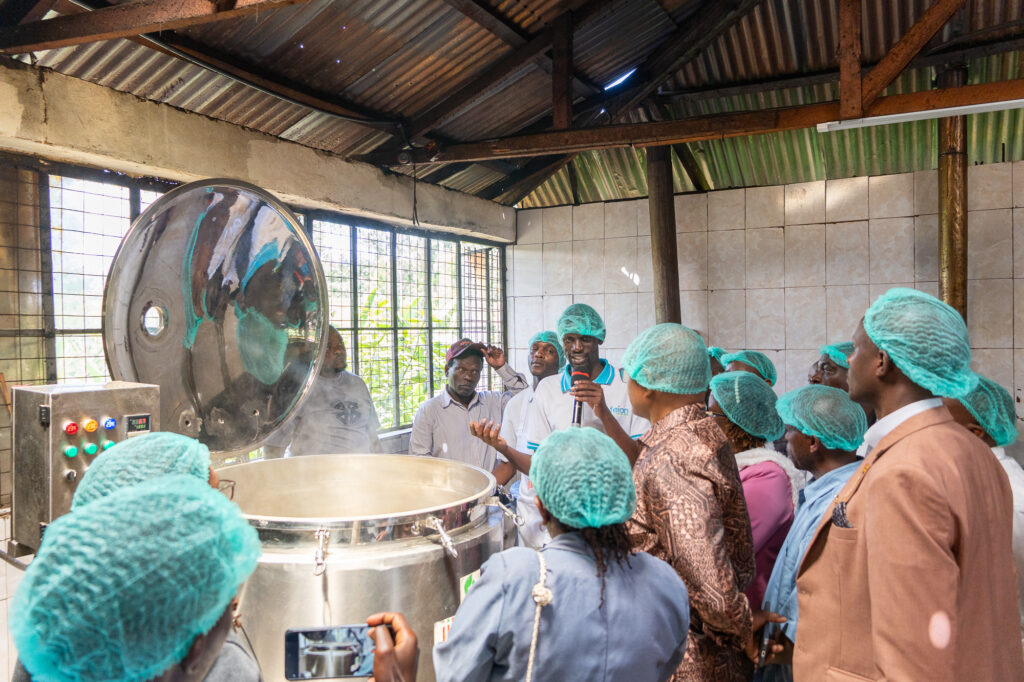
When the Feion team installed the Jiko-Kul at Ndima Kanini Academy, they told the kitchen staff that beans would cook in under an hour.
The cooks didn’t believe them.
Then they watched it happen.
What One Hour Means
An hour is an abstraction until you have spent years waiting four.
For the kitchen staff at Ndima Kanini, that recovered time is not a statistic. It is the difference between starting lunch prep at 5 AM and starting at 9 AM. It is the difference between spending the entire morning managing a fire and spending it preparing a second dish – a vegetable, a fruit, something the students haven’t had before.
It is the difference between exhaustion and dignity.
But the clock is only the beginning.
Follow the Money
Every shilling Ndima Kanini Academy spent on firewood was a shilling that did not buy a textbook. Did not repair a desk. Did not fund a lab. Did not send a teacher to a training workshop.
This is the invisible tax that firewood levies on schools across Kenya – a tax paid not in one dramatic invoice, but in thousands of small, daily surrenders. A bundle here. A delivery there. A budget line that grows while everything else shrinks.
The Jiko-Kul ended that.
No more firewood purchases. No more price negotiations with suppliers whose rates climb every dry season. No more budget uncertainty.
The savings are not theoretical. They are real, they are immediate, and they are being redeployed – into the things that actually make a school a school.
Follow the Smoke
Here is something that rarely makes it into a school’s annual report: the health of the women who cook.
Across Kenya, kitchen staff – overwhelmingly women – inhale wood smoke equivalent to smoking multiple cigarettes a day. Chronic coughs. Irritated eyes. Respiratory conditions that develop slowly and are treated late, if at all. It is an occupational hazard that has been normalized because it has always existed.
At Ndima Kanini, the kitchen is now smoke-free.
That sentence is easy to read. It is harder to appreciate until you have stood in a firewood kitchen at noon, wiping your eyes, tasting ash in the back of your throat, and realized that someone does this every single day.
The Jiko-Kul didn’t just change the cooking. It changed the air.
Follow the Trees
Kenya loses thousands of hectares of forest cover every year, and school kitchens are a significant contributor. Not because any single school consumes an unreasonable amount of firewood, but because there are over 40,000 schools, and the aggregate demand is staggering.
Every institution that transitions away from firewood is a small withdrawal from that demand. Multiply Ndima Kanini’s impact by a thousand schools – ten thousand – and the arithmetic shifts from hopeful to transformative.
One cooker will not save a forest. But one cooker, replicated across a system, begins to change the equation.
“The Food Is Different Now”
This is the part that surprised even us.
Students at Ndima Kanini noticed the change before the budget reports confirmed it. The food tasted better. Beans were softer. Rice was fluffier. Meals arrived on time, consistently, without the burnt-bottom flavor that firewood cooking occasionally produces.
Pressure cooking does something firewood cannot: it cooks evenly, under controlled conditions, preserving nutrients and texture. It is not just faster. It is better.
And when students eat well, they sit in afternoon classes with full stomachs and focused minds. The connection between kitchen and classroom is direct. It always has been. We just rarely talk about it.
How Schools Afford This
The most honest question any school administrator asks: How do we pay for it?
We built our financing around one insight – if you are already spending money on firewood every month, you can redirect that same money toward owning a system that eliminates firewood forever.
Lease-to-Own
The school’s existing firewood budget becomes the instalment. Many schools find that the transition is cost-neutral from month one. Over time, the maths tilts decisively in the school’s favor – they own the equipment, and the fuel cost drops to a fraction of what it was.
Direct Purchase
For schools with the capital, outright ownership delivers immediate, full savings.
Partner-Backed Financing
Working with institutions like KCB Bank and mission-aligned partners, we structure solutions that make the upfront barrier disappear – bundling equipment, installation, commissioning, and training into one accessible package.
The goal is simple: no school should keep burning firewood because the alternative felt financially out of reach.
Why Ndima Kanini Matters Beyond Ndima Kanini
Every installation Feion Green Ventures completes is a proof point. Not a pilot. Not an experiment. Proof.
Proof that institutional electric cooking works at scale. That the economics are sound. That the health outcomes are real. That the environmental benefit compounds. That students notice the difference.
Ndima Kanini Academy joins a growing network of schools – from Lugulu Girls High School in Western Kenya to institutions across the country – that have made the transition and have not looked back.
But 40,000 schools remain. Billions of shillings are still being burned as firewood. Hundreds of thousands of tonnes of CO₂ are still rising from school kitchens that could be smoke-free tomorrow.
The blueprint exists. The technology is proven. The financing models work.
What remains is the will to scale.
The Invitation
We are not looking for applause. We are looking for partners.
Development organizations who want their climate funding to produce measurable, verifiable, lasting impact at the institutional level.
Financiers who understand that clean cooking infrastructure is an investable asset class with proven returns and built-in demand.
School administrators who are tired of watching their budgets disappear into woodpiles and are ready to make the switch.
Government agencies who see the connection between school kitchens and national climate commitments – and want to act on it.
The future of school cooking in Kenya is not firewood. It is clean, electric, efficient, and already here.
One kitchen changed at Ndima Kanini. Forty thousand more are waiting.
Feion Green Ventures designs, manufactures, and deploys the Jiko-Kul Electric Pressure Cooker and solar hybrid systems for schools and institutions across Kenya. To explore a deployment at your institution, reach us at info@feiongreenventures.com